Bali’s tap water is one of those questions where almost everyone has an answer and almost nobody has a source. The municipality of Denpasar publishes a 459-page water master plan containing the actual figures. It is in Indonesian, it is not indexed in English, and it is more candid than any blog post on the island.
Read together, its numbers say something specific: the utility claims the water is drinkable, and simultaneously reports that about 17% of customers do not receive optimal quality.
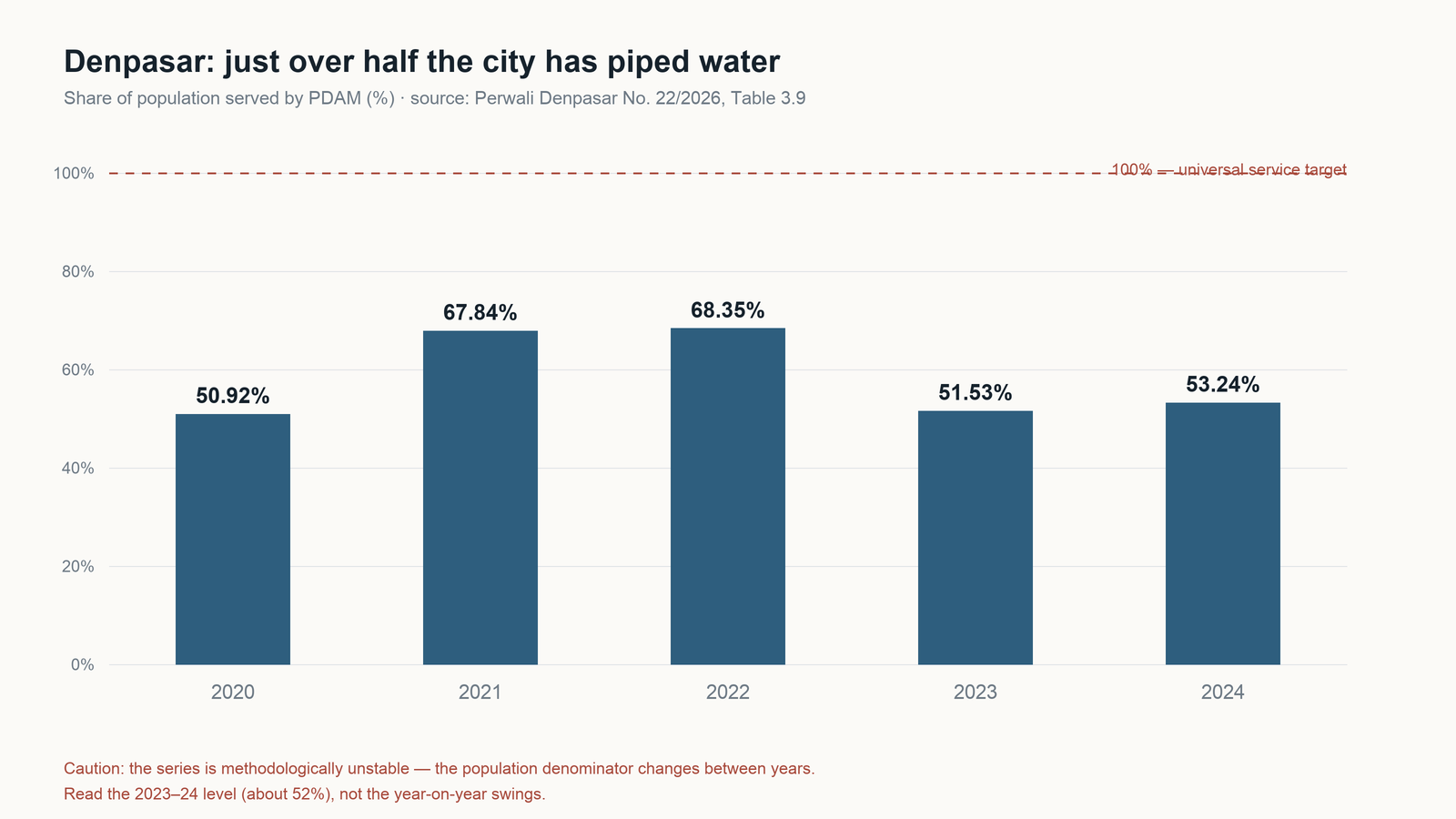
Roughly half the city is not on the pipe
Denpasar’s piped network served 53.24% of the population in 2024 (51.53% in 2023), across 91,605 active connections. The same document estimates that 40–50% of residents meet their drinking-water needs outside the piped network — dug wells, boreholes, bottled water and refill water — and describes that consumption as “relatively high”.
This is the context that no bottled-water advertisement mentions: most of Denpasar is not drinking municipal water at all.
The utility’s own quality figure is 82.79%
Assessed against Indonesia’s drinking-water standard, Permenkes 2/2023, the utility’s 2023 performance report puts customer water quality at 82.79%. The document then concedes that “there remain around 17% of customers who do not yet receive optimal water quality, whether in terms of clarity, colour, taste or pressure.”
That is the single most useful sentence in the whole plan — and it is a compliance figure across all parameters, not a contamination rate. It should not be read as “17% of taps have bacteria”.
But it does legally claim potability
On the strength of 3,536 samples in 2024, with residual chlorine at a maximum of 1 mg/L at the reservoir and still above the 0.2 mg/L minimum at the furthest distribution point, the utility concludes the water “can be categorised as drinking water fit for public consumption”.
Both statements are true at once. The standard it is measured against is strict on paper — E. coli 0 CFU/100 mL, total coliform 0, TDS under 300 mg/L — and the utility’s own compliance rate against it is 82.79%.
The statistic that hides the problem
Indonesia’s statistics agency reports that 98.32% of Bali households have “access to a safe drinking water source” — the second-highest province nationally. That indicator counts bottled water, refill water and protected springs as “safe”. The gap between 98% and roughly half the city having a pipe is the whole story.
What service actually looks like
Coverage is not the same as service. In Uluwatu, connected households report that “on a good day, water moves through the pipes for an hour”, with residents leaving taps open to hear when it arrives.
Non-revenue water in Denpasar was 34.52% in June 2025 and 35.96% in 2023, against a Ministry ceiling of 25% — 34,965,595 m³ produced against 23,022,996 m³ sold in 2024. The plan blames ageing pipes, broken meters and unstable pressure.
When pipes fail, tankers substitute at a multiple of the pipe tariff: around Rp70,000 per m³ in Uluwatu against Rp1,780 for the first 10 m³ of household PDAM water — roughly forty times the unit price.
What hotels do, and what it tells you
ITDC began operating a sea-water reverse-osmosis plant for The Nusa Dua in January 2026, with a ministry permit, to secure supply for its hotels and villas. Meanwhile PDAM Badung’s own desalination plan is still in feasibility study, and its director is blunt about why: the output is drinking-grade but the network is too old to receive it — “that is not viable” — with only 30–40% usable as drinking water and costs described as very high.
That is a verdict on pipes, not on seawater.
So what should a household or villa do?
Assuming municipal water is drinkable is a claim the utility makes and partly meets. Treating it as reliably optimal is not supported by its own 82.79%. The practical layering is:
- Sediment and carbon at the point of entry for the clarity, colour and taste complaints the utility itself lists — and for the sediment that intermittent pressure pushes into lines.
- Reverse osmosis at the kitchen if you want drinking water independent of pipe quality. In coastal areas this is not optional: see our companion piece on salt intrusion, where wells measured 10,000–20,000 mg/L.
- Water storage if supply is an hour a day, with a cleaning schedule — a tank left alone becomes its own problem.
Under-sink systems · Whole house systems · Cartridges
Reading notes: the coverage series in the master plan is methodologically unstable — the population denominator changes between years — so we quote the 2023–24 level rather than year-on-year swings. We could not verify a current province-wide piped coverage figure; published numbers conflict badly, so we have not printed one. And the 82.79% figure is a quality-compliance rate, not a contamination rate.
Sources
- Peraturan Walikota Denpasar No. 22/2026 (water master plan; coverage Table 3.9, NRW, tariff schedules, quality compliance) — peraturan.bpk.go.id (PDF)
- Permenkes No. 2/2023 drinking-water parameters (E. coli 0, coliform 0, TDS <300 mg/L) — labkesda.surakarta.go.id
- BPS 2024 household access to a safe drinking-water source — databoks.katadata.co.id
- The Guardian on Uluwatu supply and tanker prices (14 July 2026) — theguardian.com
- ITDC sea-water RO plant for The Nusa Dua (January 2026) — bali.jpnn.com
- BaliPost on PDAM Badung’s SWRO feasibility findings (17 November 2025) — balipost.com
- NusaBali on tanker water prices in Karangasem — nusabali.com